

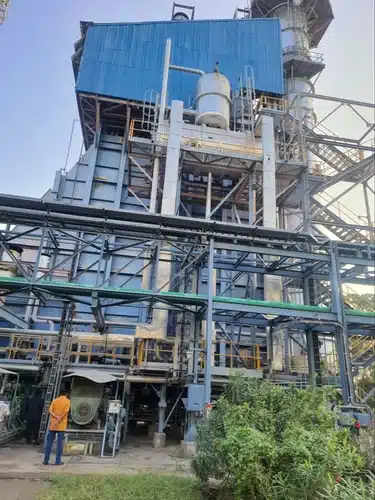
A boiler can show an efficiency number.
But that number alone does not tell you why the boiler is efficient — or where your money is going when it is not.
That is why calculating boiler efficiency should not be treated simply as a mathematical exercise.
It should be used as a diagnostic tool.
Boiler efficiency is commonly calculated using two approaches:
the direct method, also known as the input-output method,
and
the indirect method, often called the heat-loss or energy-balance method.
Both can be useful.
But when my objective is to understand and optimize the performance of a coal-fired boiler, I prefer the indirect approach because it does something the direct calculation cannot do by itself:
it shows where the energy is being lost.
What is boiler efficiency?
Boiler efficiency represents the proportion of the fuel energy entering the boiler that is converted into useful thermal output.
In its simplest form:
Boiler Efficiency (%) = Useful Energy Output / Fuel Energy Input × 100
If a boiler receives 100 units of fuel energy and converts 88 units into useful output, its efficiency is approximately 88%.
The remaining energy has not disappeared.
It has left the defined boiler boundary through different losses.
And understanding those losses is where boiler optimization begins.
What does ASME PTC 4 say about boiler efficiency?
For fired steam generators, one of the principal international references is ASME PTC 4 — Fired Steam Generators.
The current ASME listing is PTC 4-2013 (R2023). The Code provides rules for conducting performance tests on fired steam generators, including units fired with coal, oil and gas.
ASME describes PTC 4 as a comprehensive document for determining and testing fired steam-generator efficiency using the Energy Balance Method, as well as other important performance parameters.
Its terminology is useful to understand:
- what industry commonly calls the direct method corresponds broadly to an input-output approach;
- what is commonly called the indirect or loss method corresponds to an energy-balance approach.
ASME PTC 4 treats energy losses, energy credits, measurements, uncertainty and test boundaries explicitly. Therefore, a formal PTC 4 performance test is more rigorous than simply subtracting three estimated losses from 100%.
Method 1: Direct boiler efficiency calculation
The direct method compares the useful energy produced by the boiler with the energy supplied by the fuel.
In simplified form:
Boiler Efficiency = Useful Heat Output / Fuel Heat Input × 100
For a steam boiler, the calculation generally requires reliable information such as:
- steam flow;
- steam pressure and temperature;
- feedwater conditions;
- fuel flow;
- fuel heating value.
Conceptually, the method is simple.
That simplicity is one of its advantages.
What is the main limitation of the direct method?
It gives you the result, but it does not automatically explain the cause.
Suppose your boiler efficiency falls from 88% to 85%.
The direct calculation tells you that performance deteriorated.
It does not necessarily tell you whether those three percentage points came from:
excess air,
air infiltration,
poor heat transfer,
or another loss.
You still need to investigate.
That is why, for boiler optimization, I find the loss method much more useful.
Method 2: Indirect boiler efficiency calculation
The indirect method approaches the problem from the opposite direction.
Instead of asking:
How much useful energy did I obtain?
it asks:
Where did the fuel energy go?
In a simplified heat-loss calculation:
Boiler Efficiency ≈ 100% − Sum of Boiler Heat Losses
For a formal performance test, however, the exact equation, boundary, applicable losses and energy credits should follow the selected standard and test procedure.
This distinction matters.
ASME PTC 4 includes specific sections for the steam-generator energy balance, losses, credits and uncertainty analysis rather than treating boiler efficiency as a simple three-variable calculation.
What are the main boiler efficiency losses?
The applicable losses depend on fuel, boiler configuration, test boundary and calculation basis.
For a coal-fired boiler, several losses deserve particular attention.
1. Dry flue gas loss
One of the most important losses is the sensible heat leaving the boiler with the dry combustion gases.
In simplified terms:
Dry Flue Gas Loss (%) = Heat carried by dry flue gas / Fuel energy input × 100
This loss depends strongly on factors such as flue-gas temperature and the amount of gas moving through the boiler.
And that makes it extremely useful diagnostically.
High dry-gas loss may lead you to investigate:
- excessive O₂ or excess air;
- air infiltration;
- fouled heat-transfer surfaces;
- deteriorated economizer performance;
- air-heater performance;
- abnormal exit-gas temperature.
The U.S. Department of Energy highlights stack temperature and flue-gas oxygen as primary indicators of combustion efficiency and notes that excessive air increases the mass of hot gas leaving through the stack.
So when I see this loss moving, I do not simply write down a percentage.
I ask:
Why is it moving?
That is where the engineering starts.
2. Moisture in the fuel
Coal contains moisture.
Some of it may be inherent to the coal and some may be influenced by storage and handling conditions.
Energy is required to heat that moisture and carry it from the boiler as water vapor.
That energy is therefore unavailable for generating useful steam within the boiler boundary.
This makes coal moisture important not only for fuel purchasing but also for boiler performance.
A change in moisture can affect:
- the amount of coal required;
- flame conditions;
- mill performance;
- flue-gas flow;
- boiler efficiency.
This is one reason why comparing two coals only on a price-per-ton basis can be misleading.
The boiler does not earn money from tonnes.
It needs energy.
3. Water formed from hydrogen in the fuel
There is another source of water that should not be confused with the original moisture in the coal.
Hydrogen contained in the fuel reacts with oxygen during combustion and forms water vapor.
On an HHV-based efficiency calculation, the energy associated with keeping this water as vapor is normally reflected as a loss.
This introduces one of the most important rules when comparing boiler efficiencies:
Always know whether the calculation is based on HHV or LHV.
An efficiency reported on an LHV basis will normally appear higher than the same boiler efficiency calculated on an HHV basis.
Comparing them without identifying the energy basis can lead to the false conclusion that one boiler performs better than another.
4. Moisture in combustion air
Ambient air also contains water vapor.
Its contribution may be relatively small compared with other losses, but a complete energy balance can account for the energy associated with heating that moisture.
This is also why ambient conditions should not simply be ignored in rigorous performance testing.
5. Unburned carbon in ash
This is one of the losses I pay particular attention to in coal-fired boilers.
If carbon leaves the boiler in fly ash or bottom ash without completing combustion, part of the fuel’s chemical energy leaves with it.
The energy was purchased.
The coal entered the plant.
But part of it was never converted into useful heat.
High unburned carbon can point toward areas such as:
- coal fineness;
- pulverizer performance;
- fuel-air distribution;
- burner balance;
- combustion residence time;
- secondary-air distribution;
- coal reactivity.
This is why LOI or unburned carbon should never be treated as just another laboratory number.
It can represent energy leaving your boiler.
6. Loss due to incomplete combustion
Incomplete combustion may also appear through combustible gases such as carbon monoxide.
There is an important balance here.
Too much excess air increases the amount of hot flue gas leaving the stack and can reduce efficiency.
Too little effective combustion air or poor mixing can increase incomplete combustion.
DOE guidance similarly warns that insufficient air can lead to unburned combustibles while excessive air increases stack heat losses.
So the objective is not:
reduce O₂ as much as possible.
The objective is:
operate with the appropriate air-fuel relationship for safe, stable and efficient combustion.
7. Radiation and convection losses
Not all energy leaves through the chimney.
Some heat is transferred from the external boiler surfaces to the surrounding environment by radiation and convection.
In simplified form:
Radiation and Convection Loss (%) = Surface heat loss / Fuel energy input × 100
These losses can point toward:
- damaged insulation;
- deteriorated refractory;
- hot external surfaces;
- missing or damaged lagging.
But they also have an important characteristic:
they do not necessarily change proportionally with boiler load.
That means their percentage impact can become larger at low load, even when the absolute surface heat loss has not changed dramatically.
8. Sensible heat in ash and residue
In solid-fuel boilers, hot fly ash, bottom ash or other residue can also carry energy outside the boiler boundary.
Its importance depends on the boiler technology, amount of residue and discharge temperature.
For coal-fired units with high ash content, ignoring residue-related effects can oversimplify the energy balance.
How is boiler efficiency calculated by the loss method?
Once the applicable losses have been quantified on a consistent basis, the simplified calculation is:
Total Heat Losses = L₁ + L₂ + L₃ + … + Lₙ
and:
Boiler Efficiency ≈ 100% − Total Heat Losses
For example, imagine that the applicable losses from a simplified assessment add up to:
12.4%
The estimated boiler efficiency would be:
100 − 12.4 = 87.6%
But the number 87.6% is not the most valuable result.
The valuable information is knowing how that 12.4% is distributed.
Suppose:
7% is associated with flue gases,
2.5% with moisture-related effects,
1.5% with unburned carbon,
and the remainder with surface and other losses.
Now you have a map.
And a map gives operations and maintenance teams somewhere to start.
Why do I prefer the indirect method for boiler optimization?
I do not prefer it simply because it produces another efficiency percentage.
I prefer it because it converts efficiency into a loss map.
A direct calculation can tell me:
Your boiler efficiency is 86%.
The loss method can help me ask:
Why?
Is stack temperature increasing?
Has excess O₂ increased?
Is air entering somewhere it should not?
Did coal moisture change?
Has LOI increased?
Is the air heater performing differently?
Are heat-transfer surfaces fouled?
Has boiler load changed?
Those questions lead to actions.
And actions create savings.
Is the indirect method always more accurate than the direct method?
No.
That is an important distinction.
The indirect method is often extremely valuable for diagnostics, but its accuracy still depends on the quality of the measurements and assumptions used in the energy balance.
The direct method is also affected by uncertainty in measurements such as fuel flow, steam flow and fuel heating value.
A rigorous performance test therefore needs more than equations.
It needs appropriate instrumentation, representative sampling, stable test conditions and uncertainty analysis.
ASME Performance Test Codes are designed specifically around accuracy, precision, reliability and test uncertainty.
So I would not ask:
Which method is always more accurate?
I would ask:
Which method gives me the information and uncertainty level required for the decision I need to make?
Boiler efficiency versus combustion efficiency: are they the same?
No.
These terms are sometimes used interchangeably, but they should not be.
Combustion efficiency focuses primarily on how effectively the combustion process converts fuel energy while accounting for combustion-related flue-gas losses.
Boiler efficiency considers the overall conversion of fuel energy into useful boiler output within the selected boundary.
For example, DOE defines combustion efficiency for certain boiler applications in terms of fuel input minus flue losses, while thermal efficiency includes additional effects such as radiation and convection from the boiler shell.
So when someone tells you:
“Our efficiency is 88%,”
your next question should be:
Which efficiency? And on what basis?
What data do you need to evaluate a coal-fired boiler?
Depending on the method and required accuracy, useful data may include:
- fuel flow;
- coal HHV or LHV;
- ultimate and proximate analysis;
- coal moisture;
- ash content;
- flue-gas O₂;
- CO where applicable;
- flue-gas temperatures;
- combustion-air temperature and humidity;
- fly-ash and bottom-ash characteristics;
- unburned carbon or LOI;
- steam conditions;
- feedwater conditions;
- boiler load.
But collecting more data is not automatically better.
The objective is to collect the right data with enough quality to explain the energy balance.
Frequently asked questions about boiler efficiency
What are the two methods used to calculate boiler efficiency?
Boiler efficiency is commonly evaluated using a direct or input-output method and an indirect or heat-loss method. ASME PTC 4 formally refers to input-output and energy-balance methods for fired steam-generator performance testing.
What is the indirect method of boiler efficiency?
The indirect method determines efficiency by identifying and quantifying the applicable energy losses from the boiler. In a simplified calculation, those losses are subtracted from 100%.
Why is the indirect method useful?
Because it does more than calculate efficiency. It helps identify which losses contribute most to the performance gap and therefore provides direction for troubleshooting and optimization.
What is usually an important boiler heat loss?
Heat carried out with the flue gas is frequently an important controllable loss. Stack temperature and excess air therefore deserve close attention, although the dominant loss depends on the fuel, boiler design and operating condition.
Does high O₂ reduce boiler efficiency?
Excessive O₂ can indicate excessive air. More excess air generally means more gas must be heated and exhausted through the stack, increasing heat loss. However, reducing O₂ too far can compromise combustion and increase combustibles, so optimization must preserve safe and stable combustion.
Should boiler efficiency use HHV or LHV?
Either basis can be used when appropriate, but the basis must be clearly identified and used consistently. HHV- and LHV-based efficiencies should not be directly compared as though they were calculated on the same basis.
The efficiency number is only the beginning
Calculating boiler efficiency tells you how your boiler is performing.
Understanding the losses tells you what to do about it.
That is the real value of the indirect method.
Do not stop at:
“Our boiler is 86% efficient.”
Ask instead:
Where is the other 14% going?
Then separate what is unavoidable from what can actually be improved.
That is how an efficiency calculation becomes an optimization strategy.
And that is part of what we work through in my Boiler Optimization Recipe: understanding each loss, connecting it with operating conditions and deciding where the plant should act first.
Because every percentage point of avoidable boiler loss is fuel you paid for but did not convert into useful energy.
If youn wanted a complete training on this subject just contact me.
And may the force of energy efficiency be with you.